
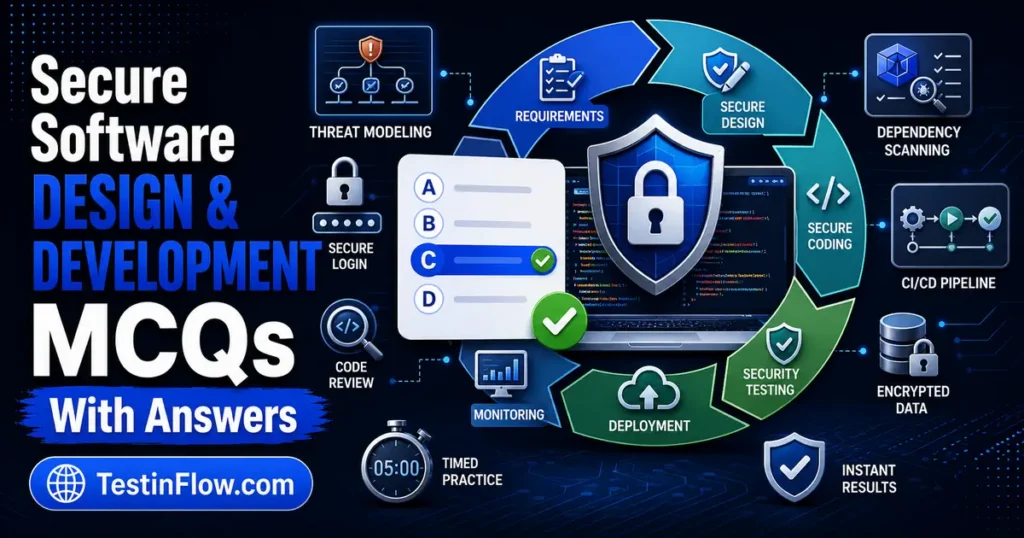
Practice these Secure Software Design & Development MCQs for university semester exams, quizzes, and software-security assessments. This mixed-difficulty set covers Secure SDLC, security requirements, threat modeling, architecture principles, secure coding, testing, DevSecOps, supply-chain security, deployment, and maintenance.
Secure Software Design & Development integrates security into every phase of the software lifecycle. It uses secure requirements, threat modeling, coding standards, testing, deployment controls, and continuous monitoring to reduce software risk.
Table of Contents
- Why Practice These MCQs?
- Important Topics Covered
- 30 MCQs With Answers
- How to Use TestInFlow
- Frequently Asked Questions
- Conclusion
Why Practice Secure Software Design & Development MCQs?
- Revise Secure SDLC phases in the correct order.
- Understand security requirements and threat modeling.
- Differentiate secure design and coding principles.
- Compare SAST, DAST, fuzzing, and penetration testing.
- Prepare for case-based software-security questions.
Semester examinations often describe a software scenario instead of naming the concept directly. You may be asked which lifecycle phase should address a weakness, which secure-coding practice prevents an attack, or which testing technique is most appropriate.
Important Topics Covered in This MCQ Set
- Secure software fundamentals
- Secure SDLC phases
- Security requirements and abuse cases
- Threat modeling and trust boundaries
- Secure design principles
- Authentication, authorization, and sessions
- Input validation and output encoding
- Cryptography and secrets management
- SAST, DAST, fuzzing, and code review
- DevSecOps, dependencies, deployment, and monitoring
Secure Software Design & Development MCQs With Answers
Secure Software and SDLC Fundamentals
Q1. Secure software development should begin during:
A. Planning and requirements
B. Final deployment only
C. Customer complaint handling only
D. Software retirement only
Correct Answer: A. Planning and requirements
Explanation: Security should be included from the earliest lifecycle phases and continue through maintenance. Beginning late makes design flaws more difficult and expensive to correct.
Q2. Which statement best describes a Secure SDLC?
A. Security activities are included throughout development
B. Security is performed only after release
C. Testing replaces design and requirements
D. Developers do not participate in security
Correct Answer: A. Security activities are included throughout development
Explanation: A Secure SDLC integrates security into planning, requirements, design, coding, testing, deployment, and maintenance. It does not treat security as one isolated task.
Q3. Which activity belongs mainly to the requirements phase?
A. Defining access-control and logging requirements
B. Rotating a production server certificate
C. Retiring an unsupported application
D. Restoring a production backup
Correct Answer: A. Defining access-control and logging requirements
Explanation: The requirements phase establishes what security behavior the software must provide. Certificate rotation and restoration occur later during operation.
Q4. What is the purpose of a security acceptance criterion?
A. To define a condition that must be met before release
B. To remove the need for testing
C. To allow every vulnerability in production
D. To replace software requirements
Correct Answer: A. To define a condition that must be met before release
Explanation: Acceptance criteria provide measurable release conditions. They help teams verify whether required security behavior has been implemented.
Q5. Which phase should include secure removal of data and accounts?
A. Software retirement
B. Requirements gathering only
C. Coding only
D. User-interface design only
Correct Answer: A. Software retirement
Explanation: Retirement includes removing access, protecting archived data, and securely disposing of unnecessary information. Security remains important after active operation ends.
Security Requirements and Threat Modeling
Q6. Which is a functional security requirement?
A. Administrators must use multi-factor authentication
B. The interface should use attractive colors
C. The application name should be short
D. The project meeting should last one hour
Correct Answer: A. Administrators must use multi-factor authentication
Explanation: This requirement defines a security function the application must perform. The other options do not specify a protection mechanism.
Q7. An abuse case describes:
A. How a system might be deliberately misused
B. Only the normal behavior of a legitimate user
C. The visual design of a screen
D. The project budget
Correct Answer: A. How a system might be deliberately misused
Explanation: Abuse cases help teams consider attacker goals and unsafe behavior. Normal use cases describe legitimate user interactions.
Q8. What is the primary purpose of threat modeling?
A. To identify threats and design mitigations
B. To generate marketing content
C. To replace every form of testing
D. To increase the attack surface
Correct Answer: A. To identify threats and design mitigations
Explanation: Threat modeling examines assets, components, data flows, and trust boundaries. It supports design decisions but does not replace testing.
Q9. A trust boundary occurs where:
A. Data moves between components with different trust levels
B. Two developers use the same keyboard
C. A user changes the screen color
D. A project changes its name
Correct Answer: A. Data moves between components with different trust levels
Explanation: Trust boundaries require careful validation, authentication, authorization, and protection. Examples include communication between a browser and a server.
Q10. Which STRIDE category involves pretending to be another user?
A. Spoofing
B. Tampering
C. Denial of service
D. Information disclosure
Correct Answer: A. Spoofing
Explanation: Spoofing concerns false identity. Tampering involves unauthorized modification, while denial of service affects availability.
Secure Design Principles
Q11. Least privilege means:
A. Granting only the access required for a task
B. Giving every user administrator access
C. Removing authentication
D. Sharing one account among all users
Correct Answer: A. Granting only the access required for a task
Explanation: Least privilege reduces the effect of compromise and mistakes. Excessive permissions increase the possible damage.
Q12. Defense in depth uses:
A. Multiple complementary security layers
B. One password as the only protection
C. No monitoring or recovery controls
D. Hidden source code as the only defense
Correct Answer: A. Multiple complementary security layers
Explanation: Defense in depth combines controls such as authentication, authorization, validation, network protection, logging, and recovery. Failure of one layer does not remove all protection.
Q13. Secure by default means:
A. The initial configuration should be safe
B. Every optional service should be enabled
C. All users should receive maximum access
D. Debug mode should remain active in production
Correct Answer: A. The initial configuration should be safe
Explanation: Secure defaults protect users who do not change the configuration. Unnecessary features and permissions should remain disabled.
Q14. A system that denies access when authorization checks fail demonstrates:
A. Fail-secure behavior
B. Open access
C. Maximum privilege
D. Security through obscurity
Correct Answer: A. Fail-secure behavior
Explanation: Fail-secure design moves the system to a safe state when an error occurs. Granting access after a failure would be unsafe.
Q15. Removing unused services primarily reduces the:
A. Attack surface
B. Need for backups
C. Number of legitimate users
D. Accuracy of audit logs
Correct Answer: A. Attack surface
Explanation: Every unnecessary service or interface creates another possible entry point. Removing unused functionality reduces exposure.
Identity, Access, and Secure Coding
Q16. Authentication determines:
A. Whether a claimed identity is genuine
B. Which actions a verified user may perform
C. How a database query is formatted
D. How long a backup is retained
Correct Answer: A. Whether a claimed identity is genuine
Explanation: Authentication verifies identity. Authorization determines the permissions assigned to that verified identity.
Q17. Which control determines whether a lecturer may modify marks?
A. Authorization
B. Compression
C. Availability monitoring
D. Output formatting
Correct Answer: A. Authorization
Explanation: Authorization controls permitted actions after identity verification. Authentication alone does not determine what the user may change.
Q18. Which practice helps prevent SQL injection?
A. Parameterized queries
B. Directly concatenating user input
C. Disabling validation
D. Displaying database errors publicly
Correct Answer: A. Parameterized queries
Explanation: Parameterized queries separate command structure from data. String concatenation can allow input to alter the intended database command.
Q19. Why must server-side input validation be performed?
A. Client-side controls can be bypassed
B. Browsers always provide trusted data
C. Validation is needed only for design documents
D. Server-side validation increases every vulnerability
Correct Answer: A. Client-side controls can be bypassed
Explanation: Attackers can send requests without using the normal interface. The trusted server must therefore validate received data.
Q20. Output encoding is primarily used to:
A. Represent untrusted data safely in its output context
B. Authenticate database administrators
C. Encrypt all backups
D. Replace access control
Correct Answer: A. Represent untrusted data safely in its output context
Explanation: Encoding prevents data from being interpreted as active content in contexts such as HTML. It is different from input validation.
Data Protection and Secrets
Q21. Where should production API keys normally be stored?
A. In an approved secrets-management system
B. In a public source-code repository
C. Inside user-facing error messages
D. In application screenshots
Correct Answer: A. In an approved secrets-management system
Explanation: Secrets-management systems provide restricted access, auditing, and rotation. Public repositories can expose credentials widely.
Q22. Which method is appropriate for storing user passwords?
A. A suitable salted password-hashing function
B. Readable plaintext
C. Reversible encoding only
D. A public spreadsheet
Correct Answer: A. A suitable salted password-hashing function
Explanation: Password-hashing functions are designed to slow guessing attempts. Plaintext or reversible encoding provides inadequate protection.
Q23. Why should developers avoid creating their own encryption algorithm?
A. Unreviewed cryptography may contain serious weaknesses
B. Custom cryptography always improves compatibility
C. Encryption removes the need for key management
D. Every algorithm is equally secure
Correct Answer: A. Unreviewed cryptography may contain serious weaknesses
Explanation: Secure cryptography requires specialist design and extensive review. Applications should use established algorithms and maintained libraries.
Security Testing and DevSecOps
Q24. SAST examines software:
A. Without running the application
B. Only through its public interface
C. Only after production deployment
D. Without accessing code or binaries
Correct Answer: A. Without running the application
Explanation: SAST analyzes source code or compiled representations statically. It can identify insecure patterns early in development.
Q25. DAST examines:
A. A running application from an external perspective
B. Only the software requirements document
C. A retired application with no execution
D. Employee training records
Correct Answer: A. A running application from an external perspective
Explanation: DAST interacts with a running application and observes its responses. It may identify runtime weaknesses without showing the exact source-code location.
Q26. Fuzz testing uses:
A. Unexpected or malformed inputs
B. Only valid production passwords
C. Marketing surveys
D. Database backups only
Correct Answer: A. Unexpected or malformed inputs
Explanation: Fuzzing looks for crashes and unsafe behavior by supplying unusual input. It is useful for parsers, protocols, and input-handling code.
Q27. DevSecOps aims to:
A. Integrate security into development and operations workflows
B. Remove developers from security decisions
C. Delay testing until after release
D. Replace every manual review with one tool
Correct Answer: A. Integrate security into development and operations workflows
Explanation: DevSecOps combines collaboration, automation, continuous testing, and monitoring. Tools support people and processes rather than replacing them entirely.
Supply Chain, Deployment, and Maintenance
Q28. What is the purpose of a Software Bill of Materials?
A. To list software components and dependencies
B. To store user passwords
C. To replace source-code review
D. To provide unrestricted administrator access
Correct Answer: A. To list software components and dependencies
Explanation: An SBOM helps organizations identify which components are included in software. This supports vulnerability response and supply-chain visibility.
Q29. Which configuration should normally be disabled in production?
A. Detailed debug mode
B. Protected security logging
C. Access control
D. Secure communication
Correct Answer: A. Detailed debug mode
Explanation: Debug mode may expose internal paths, stack traces, configuration values, or other sensitive information. Production should use safe errors and protected diagnostic logs.
Q30. Why is security regression testing important?
A. It helps prevent a corrected vulnerability from returning
B. It removes the need for secure design
C. It automatically eliminates every dependency
D. It allows production secrets in test systems
Correct Answer: A. It helps prevent a corrected vulnerability from returning
Explanation: A regression test verifies that later code changes do not reintroduce the same weakness. It becomes part of the continuing test suite.
How to Use TestInFlow for Secure Software Practice
Open the TestInFlow Smart Quiz Builder and select Secure Software Design & Development. Choose Mixed difficulty, select the number of questions, and set a suitable exam timer.
Begin with short quizzes on Secure SDLC, threat modeling, and design principles. Continue with secure coding, security testing, DevSecOps, supply-chain security, and deployment.
When your syllabus is complete, attempt a thirty- or fifty-question mixed quiz. Review each incorrect explanation and connect the question with its lifecycle phase.
Students with a teacher-provided assessment code can use the Join Quiz page. Teachers can create and share assessments through the Teacher Portal.
Frequently Asked Questions
Which Secure Software Design topics should I revise first?
Begin with Secure SDLC phases, security requirements, threat modeling, and secure design principles. Then study access control, secure coding, testing, DevSecOps, and deployment.
Are these MCQs suitable for semester exams?
Yes. The questions cover common university-level software-security concepts at mixed difficulty. Compare them with your lecturer’s outline and prescribed terminology.
How can I remember Secure SDLC phases?
Follow the normal software lifecycle and attach a security activity to each phase. Requirements define security needs, design models threats, coding implements controls, testing verifies them, and operations monitors and maintains them.
What is the easiest way to distinguish SAST and DAST?
SAST studies code without running the application. DAST interacts with a running application and observes externally visible security behavior.
Should I read detailed notes before attempting these MCQs?
Yes. MCQs are more useful after you understand the complete lifecycle. Read the matching eLecturesAI notes when threat modeling, secure coding, or DevSecOps concepts are unclear.
Conclusion
Secure Software Design & Development MCQs help you revise the Secure SDLC, threat modeling, design principles, secure coding, testing, DevSecOps, supply-chain protection, and secure deployment.
Do not memorize only the answer letters. Read every explanation, identify why the other options are incorrect, and connect each control with the lifecycle phase where it should be applied.
Want More Practice?
Use the TestInFlow Smart Quiz Builder to create your own timed Secure Software Design & Development quiz. Choose the question count and difficulty, then receive instant results with explanations.
Start Practice on TestInFlow →
Need to Understand the Concepts First?
Read detailed lecture notes on Secure SDLC, threat modeling, secure coding, application testing, DevSecOps, and deployment on eLecturesAI.
[…] Practice Secure Software Design & Development MCQs → […]
Great content! Keep up the good work!
Thank you….!!