
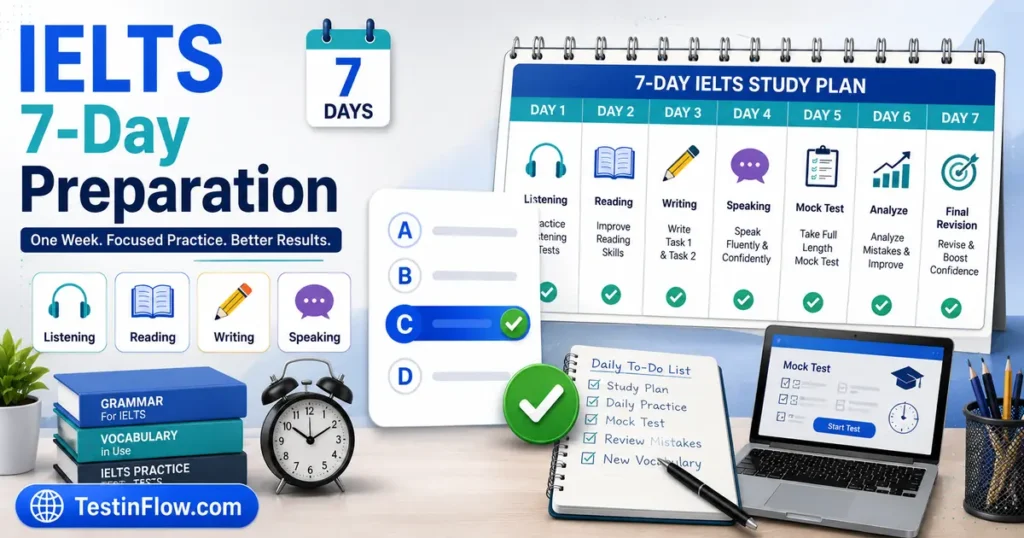
Practice these IELTS 7-day preparation MCQs to revise study planning, test format, Listening, Reading, Writing, Speaking, mock tests, and exam-day strategy. These questions are useful for beginners who want to prepare smarter in the final week before IELTS.
IELTS preparation in 7 days means using a focused one-week study plan to understand the test format, practise all four skills, improve time management, review mistakes, and take at least one mock test before exam day.
Table of Contents
- Why Practice IELTS Preparation MCQs?
- Important Topics Covered
- IELTS 7-Day Preparation MCQs With Answers
- How to Use TestInFlow for IELTS Practice
- Frequently Asked Questions
- Conclusion
Why Practice IELTS Preparation MCQs?
- Revise IELTS format and study strategy quickly.
- Check whether you understand each test section.
- Improve your preparation plan before exam day.
- Identify common mistakes in Listening, Reading, Writing, and Speaking.
- Build confidence through quick exam-focused revision.
IELTS is not only a test of English knowledge. It also tests your ability to understand instructions, manage time, organize answers, and respond accurately under pressure. These MCQs help you review the most important preparation decisions beginners must make during a 7-day study plan.
Important Topics Covered in This MCQ Set
- IELTS test format
- 7-day IELTS study plan
- Listening prediction and spelling
- Reading skimming and scanning
- Writing Task 1 and Task 2 strategy
- Speaking Part 1, Part 2, and Part 3
- Mock tests and mistake review
- Time management
- Vocabulary and grammar strategy
- Exam-day preparation
IELTS 7-Day Preparation MCQs With Answers and Explanations
IELTS Format and 7-Day Study Planning
Q1. IELTS mainly tests which four skills?
A. Listening, Reading, Writing, Speaking
B. Grammar, Translation, Literature, Dictation
C. Vocabulary, Typing, Essay, Debate
D. Reading, Science, Mathematics, Speaking
Correct Answer: A. Listening, Reading, Writing, Speaking
Explanation: IELTS assesses the four language skills: Listening, Reading, Writing, and Speaking. Grammar and vocabulary are important, but they are evaluated through these skills.
Q2. What should a beginner do on Day 1 of IELTS preparation?
A. Understand the test format and take a diagnostic test
B. Memorize 50 essays
C. Study only idioms
D. Avoid all timed practice
Correct Answer: A. Understand the test format and take a diagnostic test
Explanation: Day 1 should help you understand the exam and identify weak areas. Without a diagnostic test, your study plan may focus on the wrong skills.
Q3. What is the main purpose of a 7-day IELTS plan?
A. To focus on high-value practice and exam strategy
B. To learn the entire English language from zero
C. To avoid mock tests
D. To memorize all possible questions
Correct Answer: A. To focus on high-value practice and exam strategy
Explanation: A one-week plan should prioritize format, strategy, timed practice, and mistake review. It cannot replace long-term language development from the very beginning.
Q4. Which habit is most useful during a short IELTS preparation period?
A. Keeping a mistake notebook
B. Ignoring wrong answers
C. Practising without checking answers
D. Studying only the easiest section
Correct Answer: A. Keeping a mistake notebook
Explanation: A mistake notebook helps you track repeated problems in vocabulary, grammar, spelling, timing, and question types. Reviewing mistakes daily improves preparation quality.
Q5. Why should IELTS practice be timed?
A. Because the real exam has time limits
B. Because timing removes the need to understand questions
C. Because slow practice is always useless
D. Because answers are based only on speed
Correct Answer: A. Because the real exam has time limits
Explanation: IELTS requires both accuracy and time management. Timed practice helps beginners learn how quickly they must read, write, listen, and respond.
IELTS Listening Preparation
Q6. What should you do before the Listening audio starts?
A. Read the questions and predict answer types
B. Close the question paper
C. Write random answers
D. Ignore keywords
Correct Answer: A. Read the questions and predict answer types
Explanation: Reading questions first helps you predict whether the answer may be a name, number, place, noun, or adjective. This improves focus during the audio.
Q7. In IELTS Listening, why are synonyms important?
A. The audio may use different words with the same meaning
B. The audio always repeats exact question words
C. Synonyms are used only in Writing
D. Synonyms remove the need for listening carefully
Correct Answer: A. The audio may use different words with the same meaning
Explanation: IELTS often tests meaning rather than exact word matching. A question may use one word while the speaker uses a synonym or paraphrase.
Q8. What should you do if you miss one Listening answer?
A. Move on quickly to avoid missing the next answers
B. Stop listening completely
C. Wait until the audio ends
D. Erase all previous answers
Correct Answer: A. Move on quickly to avoid missing the next answers
Explanation: Spending too much time on one missed answer can cause more mistakes. Stay with the audio and continue to the next question.
Q9. Which detail commonly causes mistakes in Listening answers?
A. Spelling and plural forms
B. Page color
C. Font size only
D. The number of paragraphs in Writing
Correct Answer: A. Spelling and plural forms
Explanation: Incorrect spelling or missing plural endings can make an answer wrong. Beginners should practise names, numbers, dates, and common nouns carefully.
IELTS Reading Preparation
Q10. Skimming is used to:
A. Understand the main idea quickly
B. Translate every word slowly
C. Memorize the passage
D. Avoid reading completely
Correct Answer: A. Understand the main idea quickly
Explanation: Skimming helps you get the general meaning of a passage. It is useful before answering detailed questions.
Q11. Scanning helps you find:
A. Specific information quickly
B. The examiner’s personal opinion
C. Memorized essay lines
D. Speaking pronunciation errors
Correct Answer: A. Specific information quickly
Explanation: Scanning is used to locate names, dates, numbers, places, and keywords. It saves time in the Reading section.
Q12. In True/False/Not Given questions, “Not Given” means:
A. The information is not clearly stated in the passage
B. The statement is always false
C. The student should use outside knowledge
D. The answer must be guessed from personal opinion
Correct Answer: A. The information is not clearly stated in the passage
Explanation: “Not Given” means the passage does not provide enough information to confirm or contradict the statement. Do not use outside knowledge.
Q13. What should you avoid in IELTS Reading?
A. Using outside knowledge instead of passage evidence
B. Looking for keywords
C. Reading the question carefully
D. Managing time
Correct Answer: A. Using outside knowledge instead of passage evidence
Explanation: IELTS Reading answers must be based on the passage. Personal knowledge can lead to wrong answers even when the information is true in real life.
IELTS Writing Preparation
Q14. What should Academic Writing Task 1 mainly describe?
A. Main features, comparisons, trends, or stages
B. Personal stories only
C. A memorized opinion essay
D. Unrelated examples
Correct Answer: A. Main features, comparisons, trends, or stages
Explanation: Academic Task 1 requires a summary of visual information such as charts, graphs, maps, or processes. The response should focus on key features, not personal opinions.
Q15. General Training Writing Task 1 usually requires:
A. A letter
B. A graph description only
C. A scientific report
D. A speaking transcript
Correct Answer: A. A letter
Explanation: General Training Task 1 usually asks candidates to write a letter for a specific situation. Tone, purpose, and required points are important.
Q16. Which structure is suitable for IELTS Writing Task 2?
A. Introduction, body paragraphs, conclusion
B. Only one long paragraph
C. A list of memorized idioms
D. Random points without organization
Correct Answer: A. Introduction, body paragraphs, conclusion
Explanation: A clear essay structure helps the reader follow your argument. Each body paragraph should develop one main idea with explanation and example.
Q17. Why is memorizing complete essays risky?
A. The real question may be different
B. Memorized essays always answer every question
C. It improves task response automatically
D. It removes the need for grammar accuracy
Correct Answer: A. The real question may be different
Explanation: A memorized essay may not answer the exact task. Flexible structures and relevant ideas are safer than fixed answers.
Q18. What should each body paragraph in Task 2 contain?
A. One clear main idea with explanation
B. Several unrelated topics
C. Only memorized vocabulary
D. No examples or support
Correct Answer: A. One clear main idea with explanation
Explanation: Focused body paragraphs improve coherence and task response. Adding too many unrelated ideas weakens the essay.
IELTS Speaking Preparation
Q19. What is a good strategy for Speaking Part 1?
A. Give a direct answer with one or two extra details
B. Answer every question with only “yes” or “no”
C. Stay silent if unsure
D. Memorize a long speech for every question
Correct Answer: A. Give a direct answer with one or two extra details
Explanation: Part 1 answers should be natural and not too long. Adding a reason or example makes the answer stronger than a one-word reply.
Q20. What should you do during the 1-minute preparation time for Speaking Part 2?
A. Write short notes, not full sentences
B. Write a complete essay
C. Ignore the cue card
D. Memorize unrelated vocabulary
Correct Answer: A. Write short notes, not full sentences
Explanation: Short notes help you organize ideas quickly. Full sentences take too much time and may make your speech sound memorized.
Q21. Speaking Part 3 usually requires:
A. Longer discussion-style answers
B. Only one-word answers
C. Spelling names and addresses
D. Copying answers from a passage
Correct Answer: A. Longer discussion-style answers
Explanation: Part 3 asks broader questions and expects opinions, reasons, comparisons, and examples. It is more discussion-based than Part 1.
Q22. What is useful for practising IELTS Speaking alone?
A. Recording your answers and listening again
B. Only reading silently
C. Avoiding all speaking practice
D. Writing answers but never speaking them
Correct Answer: A. Recording your answers and listening again
Explanation: Recording helps you notice hesitation, pronunciation problems, grammar mistakes, and answer length. Speaking improves through active practice.
Mock Tests, Vocabulary, and Final Revision
Q23. What is the main purpose of a mock test?
A. To simulate exam conditions and identify weaknesses
B. To avoid revision
C. To guarantee a high band score
D. To replace all section practice
Correct Answer: A. To simulate exam conditions and identify weaknesses
Explanation: A mock test shows how you perform under time pressure. It helps you check stamina, timing, and repeated mistakes.
Q24. When should a beginner take a full mock test in a 7-day plan?
A. Near the end, after practising the main sections
B. Only after the real exam
C. Never
D. Before understanding the test format
Correct Answer: A. Near the end, after practising the main sections
Explanation: A full mock test near the end gives a realistic final check. Day 1 can include a shorter diagnostic test to identify starting weaknesses.
Q25. What is the best use of vocabulary in IELTS?
A. Use accurate and natural words for the topic
B. Use difficult words even if they are incorrect
C. Repeat the same word in every sentence
D. Avoid all topic vocabulary
Correct Answer: A. Use accurate and natural words for the topic
Explanation: IELTS rewards clear and appropriate language. Advanced words used incorrectly can reduce clarity and accuracy.
Q26. What should you review every night during the 7-day plan?
A. Mistake notebook
B. Only social media comments
C. Random unrelated topics
D. Exam rules from memory only
Correct Answer: A. Mistake notebook
Explanation: Reviewing mistakes helps you fix repeated errors. This is especially important when preparation time is short.
Q27. Which activity should be avoided on the final night?
A. Staying awake all night to cram
B. Light revision
C. Preparing documents
D. Sleeping properly
Correct Answer: A. Staying awake all night to cram
Explanation: Lack of sleep can reduce concentration and performance. Final-night preparation should be calm and organized.
Q28. What is the best approach if your exam is only one week away?
A. Prioritize format, strategy, timed practice, and weak areas
B. Study without any plan
C. Ignore Writing and Speaking
D. Memorize only vocabulary lists
Correct Answer: A. Prioritize format, strategy, timed practice, and weak areas
Explanation: With only seven days, focused preparation is essential. A random study approach wastes valuable time.
Q29. Which statement about IELTS preparation is most accurate?
A. Strategy and language skills both matter
B. Only memorized answers matter
C. Only grammar rules matter
D. Speaking practice is unnecessary
Correct Answer: A. Strategy and language skills both matter
Explanation: IELTS requires English ability as well as knowledge of question types, timing, and response structure. Both language and strategy improve performance.
Q30. What should you do after each practice test?
A. Review wrong answers and identify the reason
B. Forget the result immediately
C. Repeat the same mistakes
D. Stop practising all sections
Correct Answer: A. Review wrong answers and identify the reason
Explanation: Mistake analysis helps you understand whether the problem was vocabulary, grammar, timing, spelling, or misunderstanding. This makes future practice more effective.
How to Use TestInFlow for IELTS Practice
Open the TestInFlow Smart Quiz Builder and select IELTS Preparation or English Proficiency. Choose Mixed difficulty, select the number of questions, and set a suitable timer for quick revision.
Use short quizzes to revise IELTS format, study planning, Listening strategies, Reading techniques, Writing structure, and Speaking preparation. After each quiz, review explanations carefully and add repeated mistakes to your mistake notebook.
If your teacher provides an assessment code, use the Join Quiz page to enter the assigned IELTS preparation test. Teachers can also create IELTS practice assessments through the Teacher Portal.
Frequently Asked Questions
Are these IELTS preparation MCQs useful for beginners?
Yes. These MCQs help beginners revise the test format, study plan, section strategies, and common mistakes. They are best used with actual Listening, Reading, Writing, and Speaking practice.
Can MCQs improve my IELTS band score?
MCQs can improve your understanding of IELTS strategy and preparation methods. To improve your band score, you must also practise real IELTS tasks, especially Writing and Speaking.
How many IELTS preparation MCQs should I practise daily?
You can practise 10 to 20 MCQs daily during a 7-day plan. After each quiz, review the explanations and connect them with your real practice mistakes.
Should I take a mock test before or after these MCQs?
Use MCQs first for quick revision of strategy and format. Then take timed practice sections or a full mock test to apply what you learned.
What is the best way to use TestInFlow for IELTS revision?
Create timed quizzes for IELTS preparation, review your score, and read answer explanations. Use weak areas from the quiz to decide what to practise next in Listening, Reading, Writing, or Speaking.
Conclusion
IELTS 7-day preparation MCQs help beginners revise the most important strategies before the exam. They cover test format, daily study planning, Listening, Reading, Writing, Speaking, mock tests, and final revision.
Do not memorize only the correct options. Read every explanation, understand why the answer is correct, and apply the idea in your real IELTS practice. A smart one-week plan can improve your confidence, timing, and exam readiness.
Want More Practice?
Use the TestInFlow Smart Quiz Builder to create your own timed IELTS preparation quiz. Choose question count, difficulty level, and get instant results with explanations.
Start Practice on TestInFlow →
Need to Understand the Concepts First?
Read detailed lecture notes, concept explanations, and study guides for IELTS preparation on eLecturesAI before practicing MCQs.
Leave a Reply