
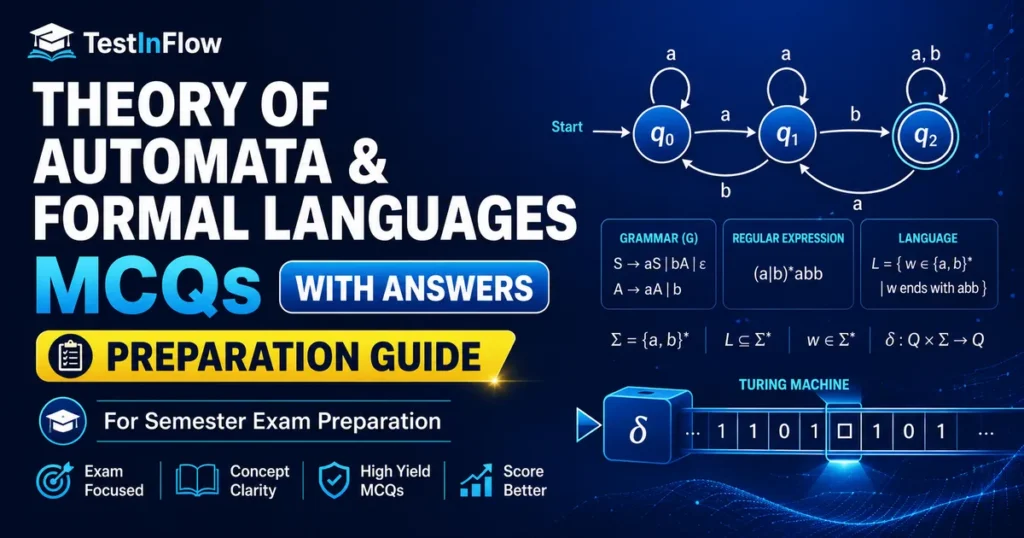
Practice Theory of Automata and Formal Languages MCQs for semester exams. Learn DFA, NFA, regular expressions, CFG, PDA, Turing machines, and formal language concepts.
Theory of Automata and Formal Languages is an important subject in Computer Science. It helps students understand abstract machines, formal languages, grammar rules, and computational models. This subject is commonly included in university semester exams, quizzes, and computer science assessments.
For many students, Automata Theory can feel difficult because it includes symbols, states, transitions, grammars, and formal definitions. Practicing MCQs is one of the best ways to revise this subject and prepare for exams.
Why Theory of Automata Is Important
Theory of Automata is the foundation of theoretical computer science. It explains how machines process input and how languages are recognized by different computational models.
This subject is important because it supports many computer science areas, such as:
- Compiler design
- Programming languages
- Algorithm analysis
- Formal verification
- Language processing
- Computation theory
Students who understand automata concepts can better understand how computers solve problems and process languages.
Why Practice Automata Theory MCQs?
MCQ practice helps students revise important concepts quickly. Instead of only reading theory, students can test their understanding through short questions.
Theory of Automata MCQs help students:
- Revise key definitions
- Understand DFA and NFA concepts
- Practice regular expressions
- Review grammar rules
- Improve exam confidence
- Identify weak topics
- Prepare for semester exams
MCQs are useful because they help students check whether they understand the concept or only remember the definition.
Important Topics in Theory of Automata MCQs
Students preparing for Theory of Automata exams should focus on the most common topics. These topics are often asked in MCQs, quizzes, and short questions.
Alphabets, Strings, and Languages
Before studying automata, students should understand basic terms such as alphabet, string, language, length of string, empty string, and set of strings.
Common MCQ topics include:
- Alphabet
- String
- Language
- Empty string
- Concatenation
- Kleene star
- Kleene plus
These basic concepts are important for understanding the rest of the subject.
Finite Automata
Finite Automata are simple computational models used to recognize regular languages. They are often represented using states, transitions, input symbols, start states, and final states.
Common MCQ topics include:
- Finite automata definition
- States and transitions
- Start state
- Final state
- Acceptance of strings
- Transition diagrams
- Transition tables
DFA and NFA
DFA stands for Deterministic Finite Automaton, while NFA stands for Non-Deterministic Finite Automaton. Students should clearly understand the difference between them.
Common MCQ topics include:
- DFA definition
- NFA definition
- Difference between DFA and NFA
- Epsilon transitions
- NFA to DFA conversion
- Accepted languages
This is one of the most important areas of Automata Theory.
Regular Expressions and Regular Languages
Regular expressions are used to represent regular languages. They are important in pattern matching, lexical analysis, and compiler design.
Common MCQ topics include:
- Regular expression symbols
- Union
- Concatenation
- Kleene star
- Language represented by regular expressions
- Conversion between automata and regular expressions
Context-Free Grammar
Context-Free Grammar, also called CFG, is used to describe languages that are more powerful than regular languages. CFG is important in compiler design and programming language syntax.
Common MCQ topics include:
- Terminals and non-terminals
- Production rules
- Start symbol
- Derivations
- Parse trees
- Ambiguous grammar
- Leftmost and rightmost derivation
Pushdown Automata
Pushdown Automata are computational models that use a stack. They are used to recognize context-free languages.
Common MCQ topics include:
- Stack operations
- Push and pop
- PDA definition
- Acceptance by final state
- Acceptance by empty stack
- Relationship between PDA and CFG
Turing Machines
Turing Machines are powerful computational models used to understand computation and decidability. They are important for advanced computer science concepts.
Common MCQ topics include:
- Tape
- Head
- States
- Transition function
- Acceptance and rejection
- Decidable problems
- Undecidable problems
- Computability
How to Prepare Theory of Automata MCQs
A good preparation method is to study one topic at a time and then practice MCQs from that topic.
Students can follow this method:
- Revise basic definitions.
- Practice MCQs on alphabets, strings, and languages.
- Study DFA and NFA concepts.
- Practice automata conversion questions.
- Revise regular expressions.
- Practice grammar-related MCQs.
- Review PDA and Turing machine concepts.
- Attempt a mixed quiz before the exam.
This method helps students prepare step by step.
Practice With a Timer
Timer-based practice is useful for semester exams because it improves speed and confidence. Automata Theory MCQs may include conceptual questions, definitions, and diagram-based understanding.
Students can practice:
- 10 MCQs in 10 minutes
- 20 MCQs in 20 minutes
- 30 MCQs in 30 minutes
Timed practice helps students manage exam pressure and answer questions more quickly.
Learn From Wrong Answers
Wrong answers help students find weak areas. If a student gets questions wrong in DFA, NFA, or CFG, they should revise that topic again.
Students should not only check the correct option. They should also read the explanation and understand why the answer is correct.
This helps improve long-term understanding.
Use TestInFlow for Automata MCQ Practice
TestInFlow provides Theory of Automata and Formal Languages MCQs with answers and explanations for students preparing for semester exams and computer science tests.
Students can also use the Smart MCQ Quiz Builder to create their own quiz. They can select Theory of Automata and Formal Languages as a subject, choose difficulty level, set a timer, and check their score instantly.
This makes preparation more active and exam-like.
Final Thoughts
Theory of Automata and Formal Languages is an important subject for computer science students. It may seem difficult at first, but regular MCQ practice can make it easier to understand.
Students should practice MCQs topic-wise, check answers, read explanations, review weak areas, and attempt timed quizzes.
TestInFlow helps students practice Theory of Automata MCQs like a real exam and improve their semester exam preparation.
Leave a Reply